Product Certification Consultancy
CE Marking
CE marking is the conformity mark which, within the scope of European Union legislation, shows that a product in certain product groups meets the relevant essential health, safety, environmental and consumer-protection requirements.
The CE mark shows that the manufacturer declares that the product meets the requirements of the relevant legislation to which it is subject and that the necessary conformity assessment procedures have been carried out. The CE mark is not, in general terms, a quality certificate or a product certificate. For CE marking to be applied, it must first be determined which European Union legislation the product falls within.
In the CE marking process, the technical characteristics and intended use of the product are assessed; the applicable legislation and standards are determined, product risks are assessed and the necessary conformity assessment activities are carried out.
Depending on the characteristics of the product and the legislation to which it is subject, activities such as testing, measurement, inspection, technical assessment or conformity assessment by a Notified Body may be necessary.
Benefits for the Organisation
The principal benefits that the CE marking process can provide to organisations are as follows:
- Establishes a systematic conformity process directed at the product meeting the essential requirements of the relevant European Union legislation.
- Helps determine the legislation and technical requirements to which the product is subject.
- Supports the identification and assessment of existing risks from the standpoint of product safety.
- Enables the necessary testing, measurement, inspection and verification work to be carried out.
- Contributes to assessing the product's conformity with the relevant standards.
- Supports the creation of the technical file and the preparation of the necessary technical documents.
- Helps establish the controls necessary for product safety in production and design processes.
- Supports the preparation of instructions for use, safety instructions and product labels in conformity with the relevant requirements.
- Contributes to the conformity assessment process being carried out in accordance with the legislation.
- Helps complete the conformity assessment process conducted with a Notified Body where required.
- Establishes the necessary basis for preparation of the EU Declaration of Conformity.
- Enables the CE mark to be used on the product in accordance with the legislation.
- Supports meeting the conformity conditions required for the product to be placed on the market in the European Economic Area.
- Contributes to increasing the confidence of customers and business partners in product safety and legal compliance.
- Helps develop the organisation's technical and regulatory basis for offering products to international markets.
Which Organisations Does It Cover?
CE marking concerns organisations that manufacture, design or place on the market products that are required to bear the CE mark within the scope of European Union legislation.
The CE mark is not mandatory for all products. Whether a product is subject to CE marking is determined by taking into account the nature and intended use of the product and the relevant European Union legislation.
The principal product groups that may fall within the scope of CE marking are as follows:
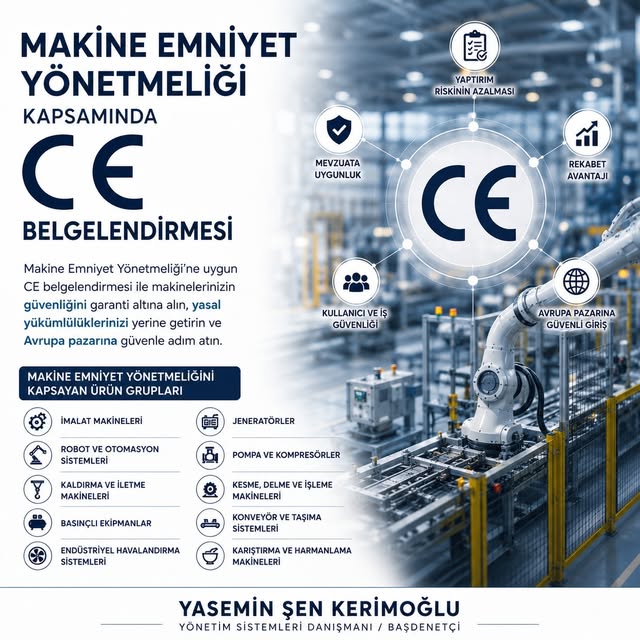
- Machinery and machine equipment
- Electrical and electronic products
- Low-voltage electrical equipment
- Products within the scope of electromagnetic compatibility
- Radio equipment and wireless communication products
- Pressure equipment
- Lifts and lift safety components
- Personal protective equipment
- Medical devices
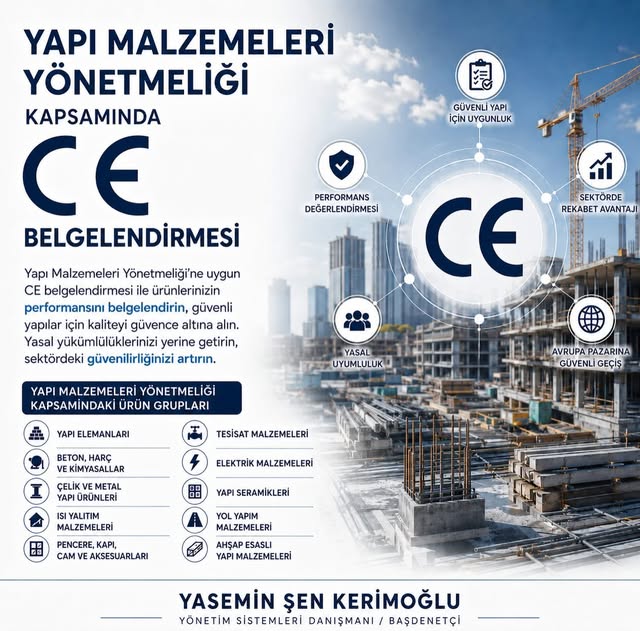
- Products subject to CE requirements within the scope of construction products
- Toys
- Measuring instruments
- Equipment and protective systems within the scope of ATEX
- Appliances burning gaseous fuels
- Certain product groups related to energy
- Other products within the scope of CE legislation
In product groups such as machinery, electrical equipment, pressure equipment, personal protective equipment and medical devices in particular, the technical requirements of the CE marking process may differ according to the characteristics of the product and the relevant legislation.
CE Marking Process
At the first stage of the CE marking process, the technical characteristics, intended use and production structure of the product are assessed and it is determined whether the product is subject to CE marking.
For products falling within the CE scope, the European Union legislation to be applied and the relevant harmonised standards are identified. The design and technical characteristics of the product are assessed against these requirements.
The risks the product presents are then identified and the necessary risk assessment is carried out. The technical and protective measures required to reduce the risks identified to an acceptable level are applied.
The necessary testing, measurement, inspection and verification work is carried out according to the conformity assessment procedure to which the product is subject. For some products the manufacturer may carry out its own conformity assessment, while in cases required by the legislation a Notified Body is included in the process.
The technical file, which is an important part of the conformity assessment process, is prepared. The technical file contains the product's technical characteristics, drawings, risk assessments, the standards applied, test results, instructions for use and other documents required by the relevant legislation.
After the necessary conformity assessment procedures have been completed, the EU Declaration of Conformity is prepared by the manufacturer and the CE mark is affixed to the product in the manner required by the relevant legislation.
After CE marking, the manufacturer must also keep the technical file and records related to conformity up to date, assess significant changes made to the product and monitor changes in the relevant legislation and standards.
CE marking carried out correctly contributes to organisations demonstrating the conformity of their products with the relevant European Union legislation, improving product safety and offering their products to the European market while meeting the relevant legal requirements.
From Instagram