System Certification Consultancy
BRCGS Food Safety Standard
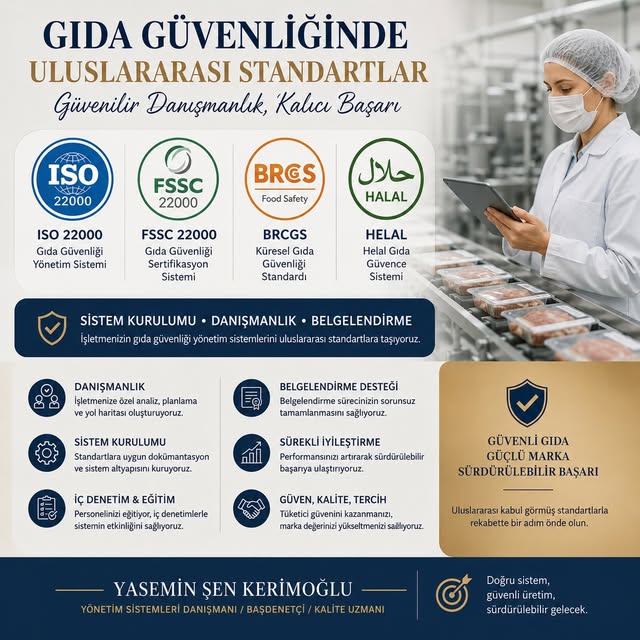
The BRCGS Food Safety Standard is an internationally recognised standard that enables food manufacturers and organisations in the food supply chain to manage food safety, quality, product integrity and legal compliance requirements systematically.
The BRCGS Food Safety Standard is widely preferred in particular by organisations operating in international food trade and supplying products to major retailers, brands or corporate customers.
The standard addresses many subjects together, including the food safety management system as well as HACCP, product and process control, premises and hygiene conditions, personnel practices, product safety, quality management and supplier management.
The basic purpose of BRCGS is to ensure that organisations produce products that are safe, in conformity with legal requirements and meeting customer expectations, and to support product safety and quality being kept under control at every stage of the production process.
Benefits for the Organisation
The principal benefits that the BRCGS Food Safety Standard can provide to organisations are as follows:
- Enables food safety hazards to be identified and controlled systematically.
- Supports the effective application of HACCP principles.
- Contributes to the systematic management of product safety and quality processes.
- Supports control of the conformity of products with legal requirements and customer specifications.
- Contributes to developing supplier and raw-material control processes.
- Enables production processes to be kept under control according to specified criteria.
- Helps hygiene and sanitation practices to be managed systematically.
- Supports the control of allergen management and contamination risks.
- Contributes to the effective application of the traceability system.
- Enables the control of nonconforming products and withdrawal and recall processes to be managed effectively.
- Supports the management of risks that may affect product integrity, such as food fraud and food defence.
- Increases employees' awareness of food safety, hygiene and quality.
- Contributes to strengthening customer and consumer confidence.
- Can increase the opportunity to work with international customers and retail chains.
- Supports the organisation's competitiveness in the international food market.
- Contributes to developing a food safety and quality culture throughout the organisation.
- Supports embedding a continual improvement approach within the organisation.
Which Organisations Does It Cover?
The BRCGS Food Safety Standard has been developed principally for organisations carrying out the processing, manufacture, packing and related activities of food products.
The standard is of particular importance for food manufacturers that supply their products to retailers, food service organisations, brands or other corporate customers.
The principal organisations to which the BRCGS Food Safety Standard may be applied are as follows:
- Meat and meat-product processing facilities
- Manufacturers of meatballs, burgers, sucuk, salami and similar processed meat products
- Dairy organisations
- Fish and seafood processing facilities
- Bread, bakery and baking organisations
- Ready-meal and catering organisations
- Frozen food manufacturers
- Canned and packaged food manufacturers
- Fruit and vegetable processing organisations
- Beverage and water manufacturers
- Confectionery and chocolate manufacturers
- Organisations producing spices, sauces and similar products
- Organisations producing food additives and certain food ingredients
- Manufacturers of plant products and oils
- Pet food and animal feed manufacturers
- The relevant BRCGS standards for organisations producing food packaging
The applicability of the BRCGS standard should be assessed according to the organisation's field of activity, products, processes and the scope of the relevant standard. For organisations operating outside food production, BRCGS may have different standards or relevant scopes.
BRCGS Certification Process
In the BRCGS certification process, the organisation's activities, products, processes and current practices are assessed first, and the gaps between the requirements of the standard and the current situation are identified.
The organisation's food safety and quality management system is established, or the existing system is developed according to the requirements of the standard. Matters such as HACCP studies, premises and hygiene practices, personnel hygiene, supplier management, product and process controls, traceability, allergen management, food defence and the prevention of food fraud are addressed systematically.
After the necessary practices have been completed, internal audits and management review are carried out. The necessary corrective actions are applied for the nonconformities identified, and the organisation is prepared for the certification audit.
The certification audit is carried out by an independent certification body accepted by BRCGS. If the requirements of the standard are met and the necessary conditions are fulfilled as a result of the audit, the organisation may be entitled to a BRCGS certificate.
A BRCGS Food Safety System applied effectively contributes to organisations improving their food safety and quality performance, meeting customer expectations, assuring product safety and positioning themselves as a reliable supplier in international food markets.
From Instagram