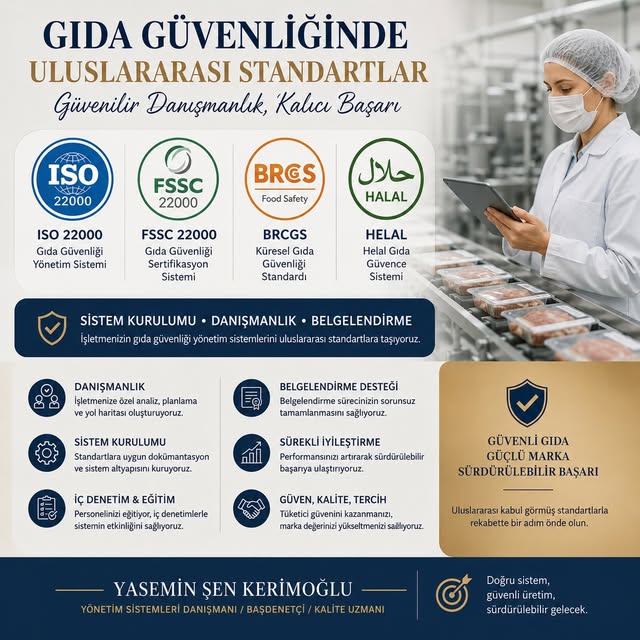
System Certification Consultancy
Halal Certification and the Halal Conformity System
Halal certification is the process of assessing the conformity of products and production processes with Islamic rules and of certifying that conformity. A halal certificate aims to assure that halal requirements are maintained in processes from the product's raw materials through production, processing, storage, packaging and dispatch.
In a halal conformity assessment, not only the final product but also the raw materials, additives and processing aids used in the product, the production equipment, the production environment, cleaning and sanitation practices, and storage and transport conditions may be taken into account.
The requirements applied within halal certification may vary according to the type of product, the field of activity and the relevant national or international halal standards on which the scope of certification is based.
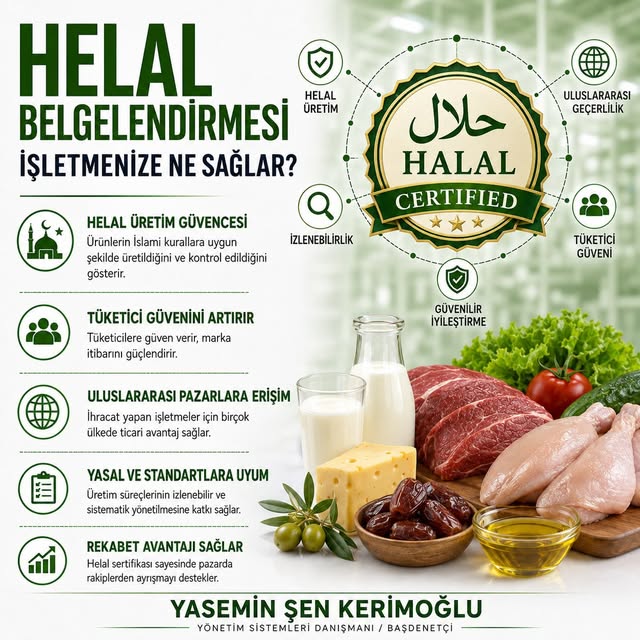
While helping consumers reach reliable products in line with their religious sensitivities, halal certification can contribute to organisations operating in halal product markets and gaining access to new markets.
Benefits for the Organisation
The principal benefits that halal certification can provide to organisations are as follows:
- Contributes to assuring that products conform to the specified halal requirements.
- Supports increasing consumers' confidence in halal products.
- Contributes to controlling the raw materials, additives and processing aids used in production processes.
- Supports reducing the risk that non-halal components, or components whose conformity has not been verified, enter the production process.
- Establishes a systematic structure for maintaining halal conformity in production, storage and transport processes.
- Contributes to developing supplier and raw-material control processes.
- Supports strengthening the traceability of products.
- Helps increase customer and consumer confidence in halal product markets.
- Can increase the opportunity to access halal product markets at home and abroad.
- Contributes to exporting organisations meeting the halal product demands of certain customers and markets.
- Helps strengthen the organisation's corporate reliability and brand value.
- Contributes to developing standardisation and control in production processes.
- Can increase the organisation's competitiveness with regard to halal products.
Which Organisations Does It Cover?
Halal certification can be applied by organisations in different sectors that wish to produce or offer products conforming to halal requirements.
Halal certification, which is widely used in the food sector in particular, can be applied across many different product groups, from meat and meat products to dairy products, and from bakery products to beverages.
The principal organisations that may be considered within the scope of halal certification are as follows:
- Meat and meat-product production facilities
- Slaughterhouses and meat-processing facilities
- Organisations producing meatballs, burgers, sucuk, salami and similar products
- Dairy organisations
- Ready-meal and catering organisations
- Bread, bakery and pastry organisations
- Confectionery and chocolate manufacturers
- Beverage manufacturers
- Water production and bottling facilities
- Frozen food manufacturers
- Canned and packaged food manufacturers
- Organisations producing spices, sauces and similar food products
- Organisations producing food additives and processing aids
- Feed manufacturers
- Organisations producing cosmetic and personal-care products
- Relevant organisations in the pharmaceutical and food-supplement sector
- Organisations carrying out the storage, logistics and distribution of halal products
- Restaurants, hotels and catering organisations offering halal products
- Other manufacturing and service organisations oriented to the halal product market
The scope of halal certification is determined according to the organisation's field of activity and the characteristics of the product or service to be certified. For this reason, the criteria and control points to be used may not be the same for every organisation.
Halal Certification Process
In the halal certification process, the organisation's activities, products, raw materials and production processes are assessed first. The products to be included in the scope of certification and the relevant halal criteria are determined.
The halal conformity of the raw materials, additives, processing aids and other components used in production is assessed. Production equipment, production areas, cleaning and sanitation practices, and storage, packaging and transport processes may also be examined.
After the organisation has established the necessary documentation and practices, document and on-site audits are carried out by the certification body. The audits assess whether halal requirements are applied effectively at the relevant stages of the production process.
If the necessary requirements are met as a result of the audit, a Halal Conformity Certificate / Halal Certificate may be issued for the relevant product or service.
Maintaining halal conformity after certification is also important. Changes in product formulations, in raw materials and suppliers, or in production processes must be controlled and their conformity with the relevant halal requirements assessed.
A Halal Conformity System applied effectively contributes to organisations assuring the conformity of their products with halal requirements, increasing consumer confidence, and reaching a stronger position in national and international halal product markets.
From Instagram