System Certification Consultancy
ISO 14064 Quantification and Reporting of Greenhouse Gas Emissions
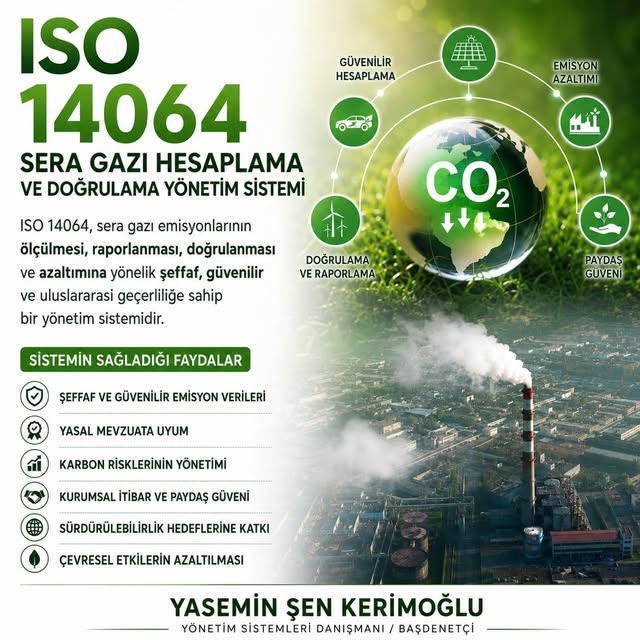
ISO 14064 is an international series of standards for organisations to determine, quantify, report and manage greenhouse gas (GHG) emissions systematically and in a verifiable manner.
ISO 14064 helps organisations present the greenhouse gas emissions arising from their activities in a measurable and comparable way, identify emission sources and improve greenhouse gas performance.
The series of standards consists of three main parts. ISO 14064-1 specifies requirements for the quantification and reporting of greenhouse gas emissions and removals at organisation level. ISO 14064-2 addresses the identification, monitoring and reporting of projects to reduce greenhouse gas emissions or enhance greenhouse gas removals at project level. ISO 14064-3 sets out principles and requirements for the verification and validation of greenhouse gas statements.
Within the scope of ISO 14064, work may include determining organisations' direct and indirect greenhouse gas emissions, classifying emission sources, establishing calculation methods, collecting data and preparing a greenhouse gas inventory.
Through this approach, organisations can set out their carbon footprints more systematically, assess emission sources and establish a reliable data basis for greenhouse gas reduction objectives.
Benefits for the Organisation
The principal benefits that greenhouse gas quantification, reporting and verification work carried out within the scope of ISO 14064 can provide to organisations are as follows:
- Enables the organisation's greenhouse gas emissions to be determined and quantified systematically.
- Contributes to establishing the organisation's carbon footprint.
- Supports the identification of greenhouse gas emission sources and significant emission points.
- Helps emission data to be established in a traceable and verifiable form.
- Enables changes in greenhouse gas emissions over the years to be tracked.
- Establishes a reliable data basis for setting emission-reduction objectives.
- Contributes to the assessment of emissions arising from energy consumption and resource use.
- Supports the identification of emission-reduction opportunities and areas for improvement.
- Contributes to the development of corporate strategies related to climate change and carbon management.
- Supports meeting the expectations of customers, investors, business partners and other interested parties regarding greenhouse gas emissions.
- Contributes to the creation of reliable data for sustainability and environmental performance reporting.
- Establishes a structure suitable for the independent verification or validation of greenhouse gas statements.
- Contributes to strengthening the organisation's environmental performance and corporate reputation.
- Supports alignment with national and international carbon management and sustainability work.
- Contributes to the development of carbon-reduction and low-carbon production strategies.
Which Organisations Does It Cover?
The ISO 14064 standards can be applied by organisations of any size that wish to quantify, report, reduce or manage greenhouse gas emissions in a verifiable manner.
Although it is an important tool in particular for organisations with high energy consumption and greenhouse gas emissions, it can be used by all organisations that wish to measure the environmental impacts of their activities and improve their carbon performance.
The principal organisations with which work can be carried out within the scope of ISO 14064 are as follows:
- Manufacturing and industrial organisations
- Food and beverage factories
- Meat and meat-product processing facilities
- Textile organisations
- Iron and steel and metal industry
- Machinery and automotive organisations
- Cement and building-materials manufacturers
- Chemical and plastics organisations
- Paper and packaging manufacturers
- Energy generation and distribution organisations
- Logistics and transport organisations
- Storage and cold-store facilities
- Mining organisations
- Construction and infrastructure organisations
- Hotels and tourism organisations
- Hospitals and healthcare organisations
- Shopping centres and commercial organisations
- Public institutions and local authorities
- Data centres and technology organisations
- Organisations developing greenhouse gas reduction projects
- Other organisations carrying out carbon management and sustainability work
The scope of an ISO 14064 application is determined according to the organisation's activities and needs. ISO 14064-1 may be used where a greenhouse gas inventory is prepared at organisation level, ISO 14064-2 for greenhouse gas reduction or removal projects, and ISO 14064-3 for the verification or validation of greenhouse gas statements that have been prepared.
ISO 14064 Implementation and Verification Process
In work carried out within the scope of ISO 14064, the organisation's activities and greenhouse gas emission sources are determined first. Emission boundaries and the reporting scope are established, and the necessary activity data and emission factors are determined.
When a greenhouse gas inventory is prepared at organisation level, the relevant emission sources are identified and greenhouse gas emissions are quantified using appropriate calculation methods. The results obtained are recorded systematically and a greenhouse gas report is prepared.
In order to increase the reliability of emission data, data sources, calculation methods, assumptions and the emission factors used are checked. Where necessary, the greenhouse gas statement may be examined by an independent verification body.
In the verification process, the conformity of the calculations, the data used, the methods and the greenhouse gas statement prepared with the relevant requirements is assessed. After the process is completed, the relevant documentation showing the verification result is prepared.
An ISO 14064 approach to greenhouse gas management and reporting, applied effectively, contributes to organisations setting out their carbon footprints reliably, setting objectives to reduce greenhouse gas emissions and making sustainability performance measurable.
From Instagram