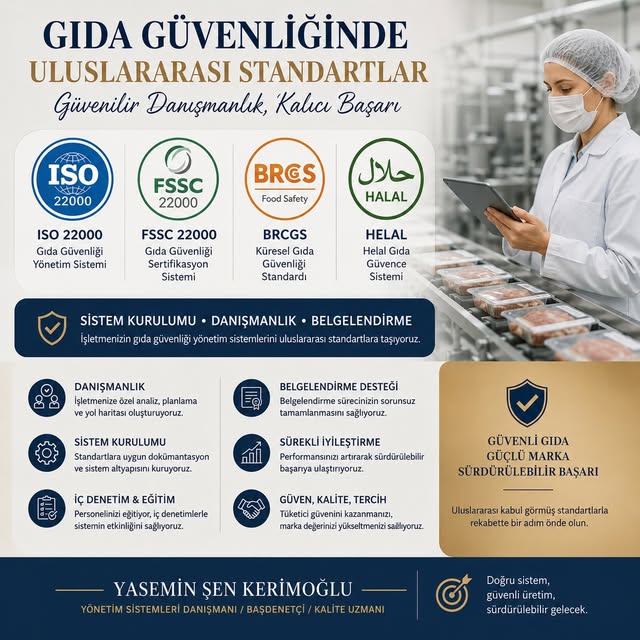
System Certification Consultancy
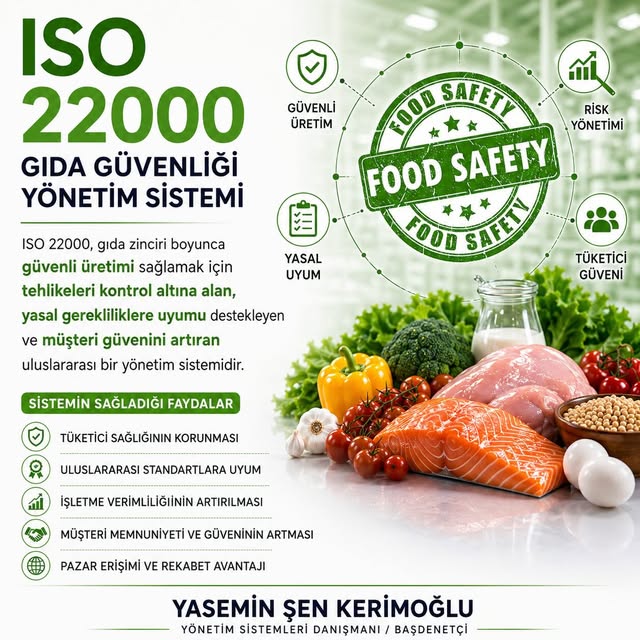
ISO 22000 Food Safety Management System
The ISO 22000 Food Safety Management System is an international management system standard that enables organisations in the food chain to identify and control hazards related to food safety systematically and to make the production of safe food sustainable.
ISO 22000 provides a systematic approach to controlling biological, chemical and physical hazards that may arise at different stages of the food chain, from acceptance of raw materials through production, storage and dispatch.
The standard brings together HACCP principles, prerequisite programmes (PRP), risk-based thinking, communication and the management system approach, and helps organisations manage their food safety performance effectively.
ISO 22000 does not focus only on the production stage. It aims for all processes that may affect food safety to be assessed as a whole and kept under control.
Benefits for the Organisation
The principal benefits that the ISO 22000 Food Safety Management System can provide to organisations are as follows:
- Enables food safety hazards to be identified and controlled systematically.
- Contributes to reducing the risks of foodborne illness and contamination.
- Supports the application of HACCP principles within a systematic management structure.
- Helps food safety to be kept under control from acceptance of raw materials through to the finished product.
- Enables critical control points and the necessary control measures to be determined.
- Supports the monitoring of legal and other applicable requirements related to food safety.
- Contributes to developing supplier and raw-material control processes.
- Supports the establishment and effective application of a traceability system.
- Helps nonconforming products to be brought under control and, where necessary, withdrawal and recall processes to be managed.
- Increases employees' awareness of food safety and hygiene.
- Enables internal and external communication related to food safety to be carried out systematically.
- Contributes to strengthening customer confidence and the organisation's reputation in food safety.
- Enables food safety performance to be monitored, assessed and continually improved.
- Contributes to meeting the food safety expectations of customers and business partners in national and international markets.
Which Organisations Does It Cover?
ISO 22000 can be applied in all organisations that are directly or indirectly part of the food chain. The size or field of activity of the organisation is not an obstacle to applying ISO 22000.
The standard can be applied to activities in direct contact with food, such as the production, processing, storage, transport, distribution and sale of food, and also to service and supply activities that may affect food safety.
The principal organisations to which ISO 22000 may be applied are as follows:
- Meat and meat-product processing facilities
- Dairy organisations
- Bread, bakery and pastry organisations
- Ready-meal and catering organisations
- Manufacturers of meatballs, burgers, sucuk, salami and similar processed meat products
- Fruit and vegetable processing organisations
- Frozen food manufacturers
- Canned and packaged food manufacturers
- Water and beverage manufacturers
- Manufacturers of spices and food additives
- Feed manufacturers
- Food storage and cold stores
- Food transport and logistics organisations
- Food wholesalers and distribution organisations
- Organisations producing food packaging
- Manufacturers of equipment and materials in contact with food
- Service providers supporting food safety, such as cleaning, disinfection and pest control services
- Retail and food sales organisations
- Other service and supply organisations for the food sector
One of the important features of ISO 22000 is that, through interactive communication and the food chain approach, it ensures that the organisation considers not only its own production processes but also the processes, from suppliers to customers, that may affect food safety.
ISO 22000 Certification Process
In the ISO 22000 certification process, the organisation's activities and its current situation with regard to food safety are assessed first. A food safety team is established, product and process information is determined, prerequisite programmes are established and food safety hazards are assessed.
In accordance with HACCP principles, hazards are analysed and the necessary control measures are determined and applied. Traceability, verification, verification activities, control of nonconformities, withdrawal and recall, and emergency processes are established. The necessary training is given to employees so that the system is applied effectively.
After the system has been implemented, internal audits and management review are carried out. Once preparations are complete, ISO 22000 certification can be granted if the requirements of the standard are met as a result of the audit carried out by an independent certification body.
An ISO 22000 Food Safety Management System applied effectively contributes to organisations keeping food safety hazards under control, ensuring the production of safe food, increasing customer confidence and continually improving food safety performance.
From Instagram