System Certification Consultancy
ISO 45001 Occupational Health and Safety Management System
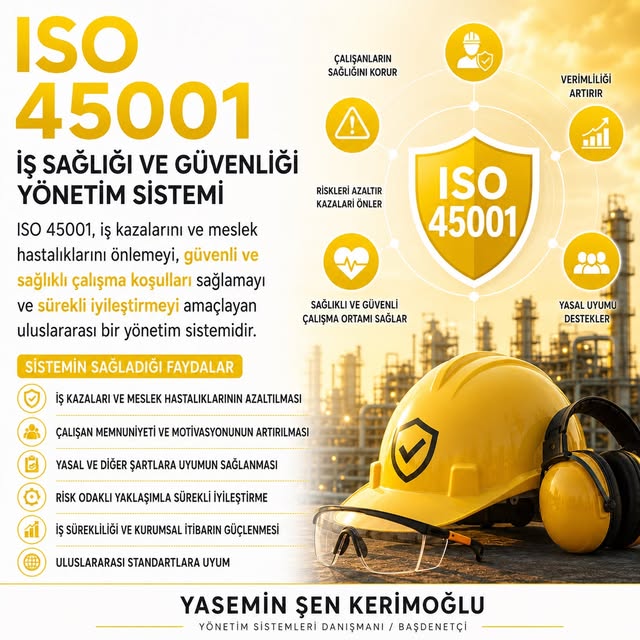
The ISO 45001 Occupational Health and Safety Management System is an international management system standard that provides for the systematic management of risks that may affect the health and safety of employees and other interested parties in the workplace.
ISO 45001 aims to prevent occupational accidents, occupational diseases and work-related health problems, to improve occupational health and safety performance continually and to create a safe working environment.
The standard addresses, within a systematic structure, matters such as identifying hazards in the workplace, assessing occupational health and safety risks, planning the necessary control measures, monitoring legal and other requirements, ensuring employees' participation in the process and being prepared for emergencies.
ISO 45001 adopts a proactive approach focused not on responding only after an occupational accident has occurred, but on preventing accidents and health problems by identifying hazards and risks in advance.
Benefits for the Organisation
The principal benefits that the ISO 45001 Occupational Health and Safety Management System can provide to organisations are as follows:
- Contributes to preventing occupational accidents and work-related injuries.
- Supports the reduction of occupational diseases and work-related health risks.
- Enables hazards in the workplace to be identified and assessed systematically.
- Helps occupational health and safety risks to be brought under control.
- Supports the monitoring and application of legal and other occupational health and safety requirements.
- Contributes to preparedness for emergencies.
- Increases employees' awareness of occupational health and safety.
- Supports employees' participation in OHS processes and the consideration of their views.
- Contributes to developing safe working methods and working conditions.
- Helps occupational accidents, near misses and nonconformities to be analysed and their recurrence prevented.
- Enables occupational health and safety performance to be measured, monitored and continually improved.
- Contributes to reducing losses of time and cost that may arise from occupational accidents and health problems.
- Strengthens the organisation's reliability in the eyes of employees, customers, suppliers and other interested parties.
- Contributes to developing a safe working culture throughout the organisation.
Which Organisations Does It Cover?
The ISO 45001 Occupational Health and Safety Management System can be applied by any organisation that has occupational health and safety risks for its employees or for other persons who may be affected by its activities.
The standard can be applied in different sectors regardless of the organisation's size, field of activity, number of employees or organisational structure. It provides an important systematic approach in particular for organisations where employees may be exposed to physical, chemical, biological, ergonomic or other occupational health and safety hazards.
The principal sectors and organisations to which ISO 45001 may be applied are as follows:
- Manufacturing and industrial organisations
- Construction and building sector
- Machinery, metal and automotive organisations
- Food and beverage organisations
- Chemical and plastics sector
- Textile and apparel organisations
- Energy organisations
- Mining activities
- Logistics, transport and storage organisations
- Maintenance, repair and technical service organisations
- Healthcare organisations and hospitals
- Educational institutions
- Hotel, tourism and accommodation organisations
- Cleaning and other field-service providers
- Public institutions and local authorities
- Engineering and technical service organisations
- Organisations employing workers in all other fields of activity
The basic approach of ISO 45001 is that the organisation identifies the occupational health and safety hazards and risks arising from its own activities and brings them under control. The control methods to be applied and the OHS objectives may therefore differ according to the organisation's activities, working environment, employees and risks.
ISO 45001 Certification Process
In the ISO 45001 certification process, the organisation's current occupational health and safety practices are assessed first. The scope and activities of the organisation are determined, hazards and OHS risks are assessed, applicable legal and other requirements are identified and the necessary management system documentation is established.
During implementation of the system, employees' participation in OHS processes is ensured, the necessary training and awareness activities are carried out, emergency preparations are made and performance is monitored. Internal audit and management review are then carried out and the effectiveness of the system is assessed.
Once preparations are complete, ISO 45001 certification can be granted if the requirements of the standard are met as a result of the audit carried out by an independent certification body.
An ISO 45001 Occupational Health and Safety Management System applied effectively contributes to organisations reducing occupational accidents and health risks, increasing the safety of employees and establishing an occupational health and safety culture based on continual improvement.
From Instagram